Greek Goddess Hekate
Hekate (or Hecate) is best known as the Greek Goddess of the Crossroads, though her origins are far older and more mysterious than many of the Olympian deities. In Hesiod's Theogony, she is described as the daughter of the Titans Perses and Asteria, the Star Goddess who rules prophecy, falling stars, and nocturnal divination. Yet Hekate's genealogy shifts from source to source. Ancient writers variously named her as the daughter of Asteria and Zeus, of Leto, of Nyx, or even connected her to older chthonic powers and the Furies. These conflicting traditions suggest that Hekate's worship may have existed before her incorporation into the Greek pantheon. Many scholars believe that her cult likely originated in Anatolia or Thrace and was later absorbed into Greek religion, explaining why no major Greek clan or tribe ever claimed descent from her and why her lineage remains so fluid.
From the earliest records, Hekate was a powerful and honored goddess. In Hesiod's account, Zeus grants her authority over heaven, earth, and sea, allowing her to bestow blessings upon mortals and Gods alike. She holds dominion over prosperity, victory, wisdom, childbirth, shepherds, sailors, and the granting of petitions. Over the centuries, however, her image evolved. Her ancient roles as Protectress, Midwife, and Nurse gradually became intertwined with her liminal functions, and she came to be revered as Queen of Ghosts, Mistress of Magick, and Guardian of the Dead. Today, many devotees experience her as a guide through psychic awakening, spiritual initiation, and life's profound transitions.
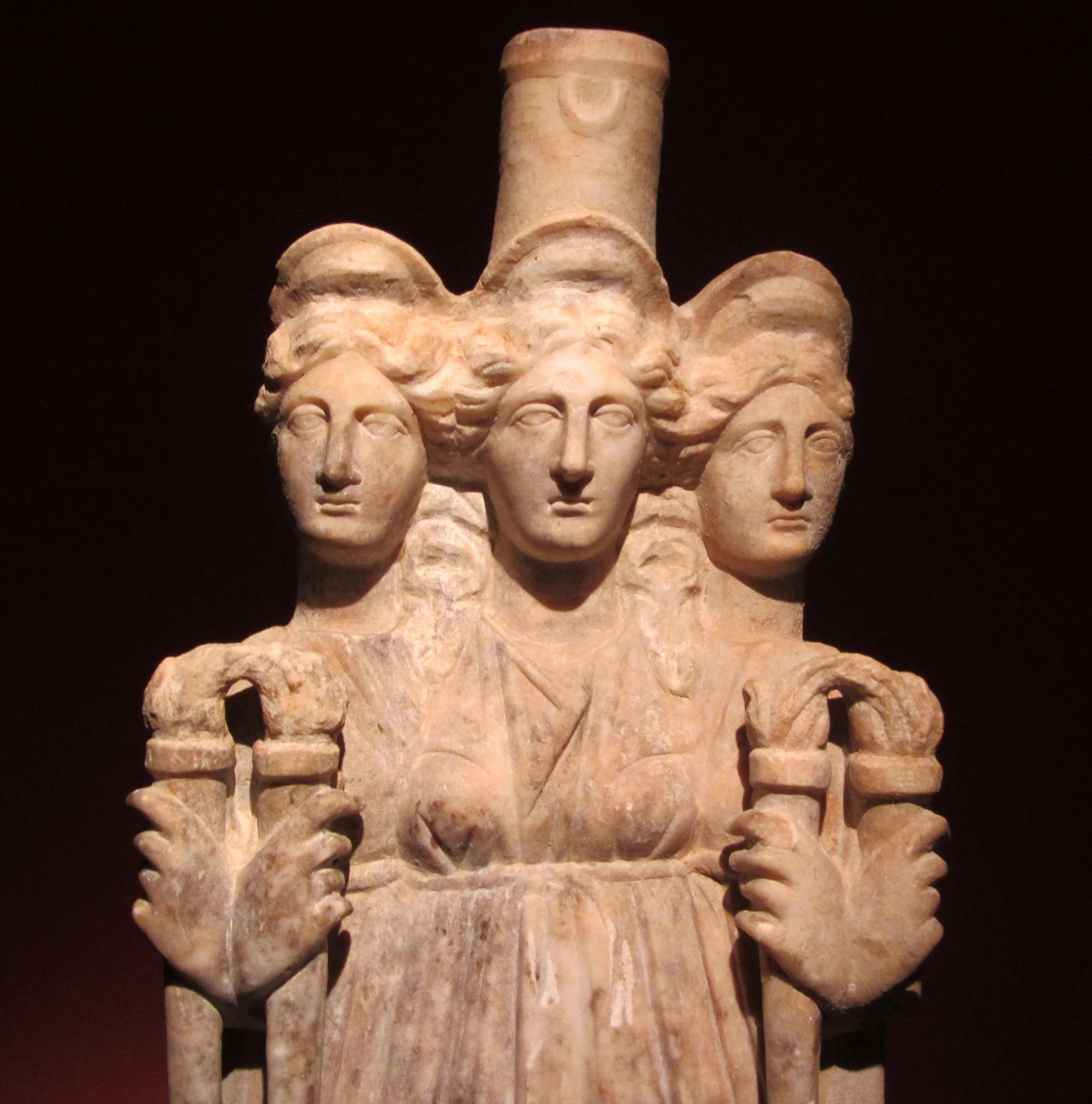
Hekate is often portrayed as a triple-formed goddess. Ancient statues known as hekataia depicted her as three women standing back-to-back, gazing in different directions. These images reflected her guardianship of crossroads and thresholds, where multiple paths converge. Later traditions associated her with the Triple Goddess archetype of Maiden, Mother, and Crone, as well as the mysteries of past, present, and future. In some ancient depictions she bears the heads of a dog, horse, and serpent, creatures that symbolize her power over the seen and unseen worlds. The Romans honored her as Trivia, "She of the Three Ways."
As a lunar and liminal deity, Hekate is often linked with Artemis and Selene. While modern traditions frequently associate her with the Dark Moon, ancient sources more often connect her with the torchlit darkness between worlds, the mysteries hidden beyond ordinary sight, and the power that emerges from shadow and transformation. She is the Sorceress, the Keeper of Keys, the Initiatrix who teaches that wisdom is often found by walking willingly into the unknown.
One of Hekate's most beloved myths is found in the story of Persephone. When Persephone is abducted by Hades, it is Hekate who hears her cries. Carrying twin torches, she accompanies Demeter in the search for the lost Maiden, traveling roads that span both the living world and the Underworld. After Persephone's return, Hekate becomes her companion and guide, moving freely between realms. In later interpretations, she serves as teacher and initiator, helping Persephone embrace her role as Queen of the Underworld and keeper of its sacred mysteries.
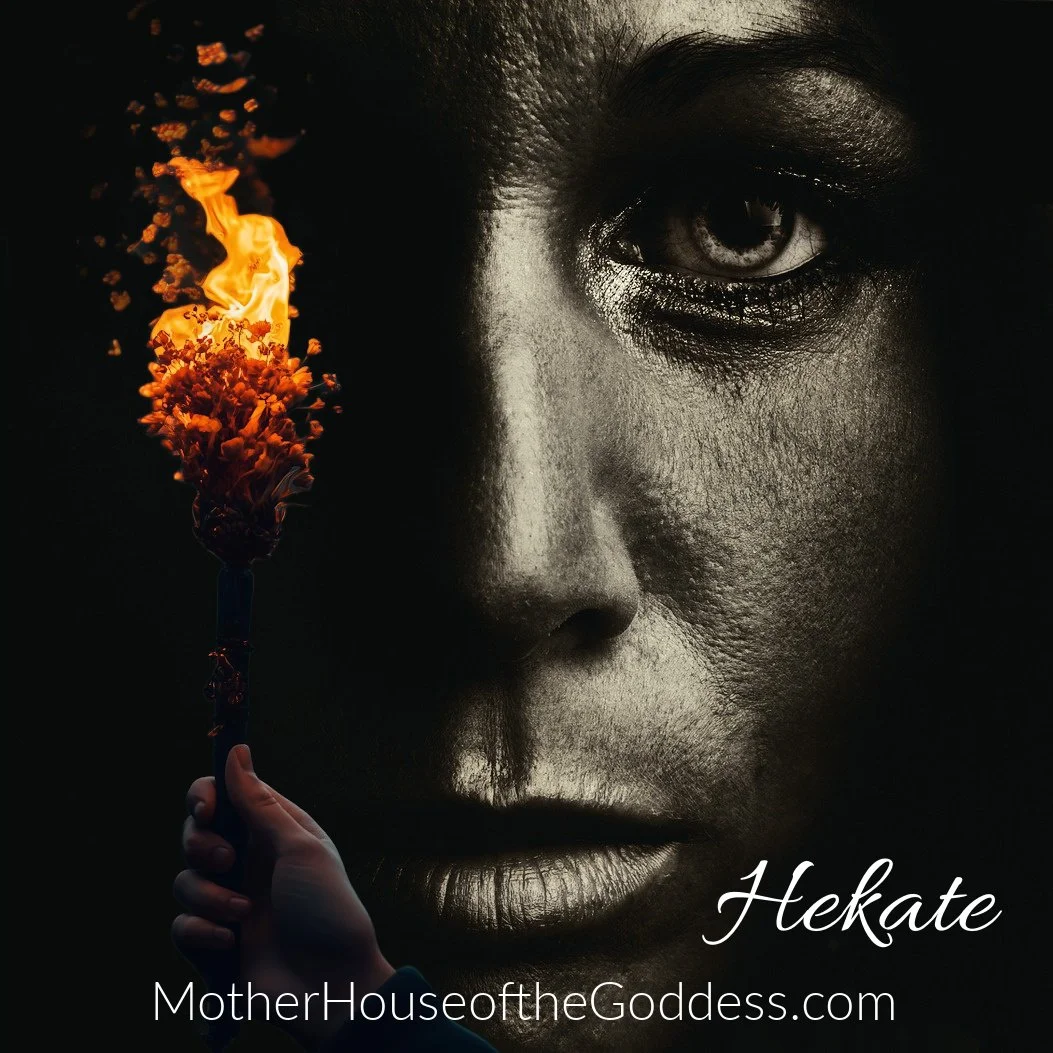
Because she moves effortlessly between worlds, Hekate is also known as a Psychopomp, a Guide of Souls. She stands at thresholds - between life and death, darkness and light, certainty and mystery. The crossroads she governs are not merely physical places but spiritual ones: moments of decision, transformation, and destiny. Whenever a life path divides and a choice must be made, Hekate waits at the threshold, torch in hand, illuminating the road ahead while honoring the mystery of what remains unseen.
The ability to traverse the boundaries of all realms is one of Hekate's most distinctive powers. Hesiod tells us that Zeus not only honored her above many others but allowed her to retain her authority after the Titanomachy, a remarkable distinction among the Titans. This elevated status has led many scholars and mythographers to view her as an ancient and enduring power whose influence reaches beyond the Olympian order itself.
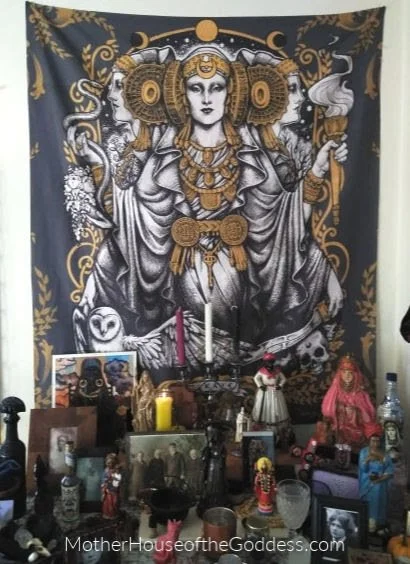
Throughout the ancient world, Hekate was honored with offerings left at crossroads, doorways, and liminal places. The dark moon feast known as Hekate's Deipnon was celebrated monthly, with food offerings placed at shrines and crossroads in her honor. These offerings often became sustenance for the poor, reinforcing her role not only as a guardian of spirits and witches, but also as a compassionate goddess who watches over society's forgotten and marginalized.
Hekate's symbols reflect her role as Guardian of Thresholds, Keeper of Mysteries, and Torchbearer through the darkness. Her most recognizable symbol is the key, representing her power to unlock hidden knowledge, open spiritual gateways, and reveal the mysteries that lie beyond ordinary perception. The torch is another of her sacred emblems, illuminating the path through uncertainty and guiding souls through both physical and spiritual transitions. At the crossroads, devotees often invoke Hekate's presence through images of the triple crossroads, symbolizing the many choices and possibilities that arise at life's turning points.
The dog, particularly the black dog, is perhaps her most beloved animal companion. Ancient sources describe the barking of dogs as heralding her approach. The serpent represents wisdom, rebirth, and hidden power, while the horse reflects her ancient connection to liminal spaces and the restless movement between worlds. Other sacred symbols include the wheel, associated with fate and transformation; the crescent moon, reflecting her connection to nocturnal mysteries; and the cauldron, symbolizing initiation, alchemy, and spiritual transformation.
To work with Hekate is to embrace the wisdom of thresholds. Her symbols remind us that every ending contains a beginning, every mystery conceals a lesson, and every crossroads offers an opportunity to choose our path with courage and awareness.
Hekate remains one of the most enduring and beloved goddesses of the ancient world. Torchbearer, Keyholder, Queen of the Crossroads, and Keeper of Mysteries, she walks beside those who stand upon the threshold of transformation. She reminds us that every ending conceals a beginning, every shadow contains wisdom, and every crossroads offers the possibility of becoming something more than we were before.
RESOURCES FOR THE GODDESS HEKATE
Hekate Devotional Online Course
Substack Article - Cakes for the Goddess Hekate & Her Supper
Hekate in Ancient Greek Religion by Robert Von Rudloff
Restless Dead: Encounters between the Living and the Dead in Ancient Greece by Sarah Iles Johnston
Hekate: Her Sacred Fires by Sorite d'Este
RED PRIESTESS- Goddess Mists, Anointing Oils, and other magickal goodies by Priestess Brandi Auset