Hindu Goddess Durga
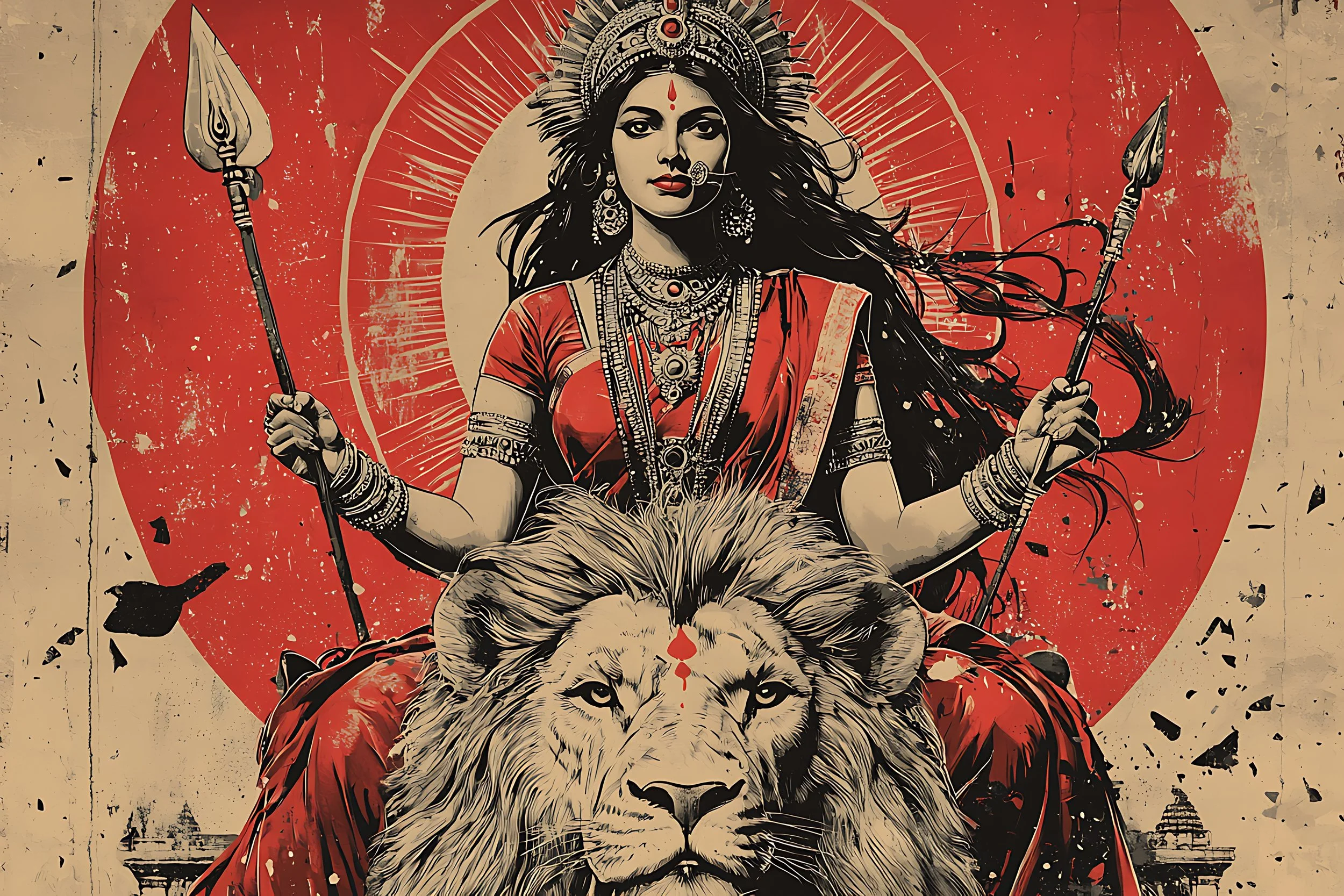
The emergence of Durga begins with a crisis that threatened not merely the world of mortals, but the very order of the cosmos itself. The demon king Mahishasura had spent countless ages performing austerities and accumulating power. Through determination, cunning, and ambition, he gained dominion over realms that belonged to the Gods and gradually expanded his influence until the celestial powers themselves trembled before him. The balance of existence hung in peril.
Recognizing the magnitude of the threat, the Gods understood that no single deity could overcome him. Together they conceived a solution unlike any before it: they would create a warrior born from their combined divine essence—a protector, a champion, a Goddess capable of restoring cosmic order.
The celestials gathered around a great sacrificial fire. One by one, they offered portions of their power into the blazing flames. Parvati cast sacred herbs and enchantments into the fire while streams of radiant energy burst forth from the mouths of the assembled deities. The brilliance intensified until a magnificent form emerged from the heart of the flames.
Thus was born Durga.
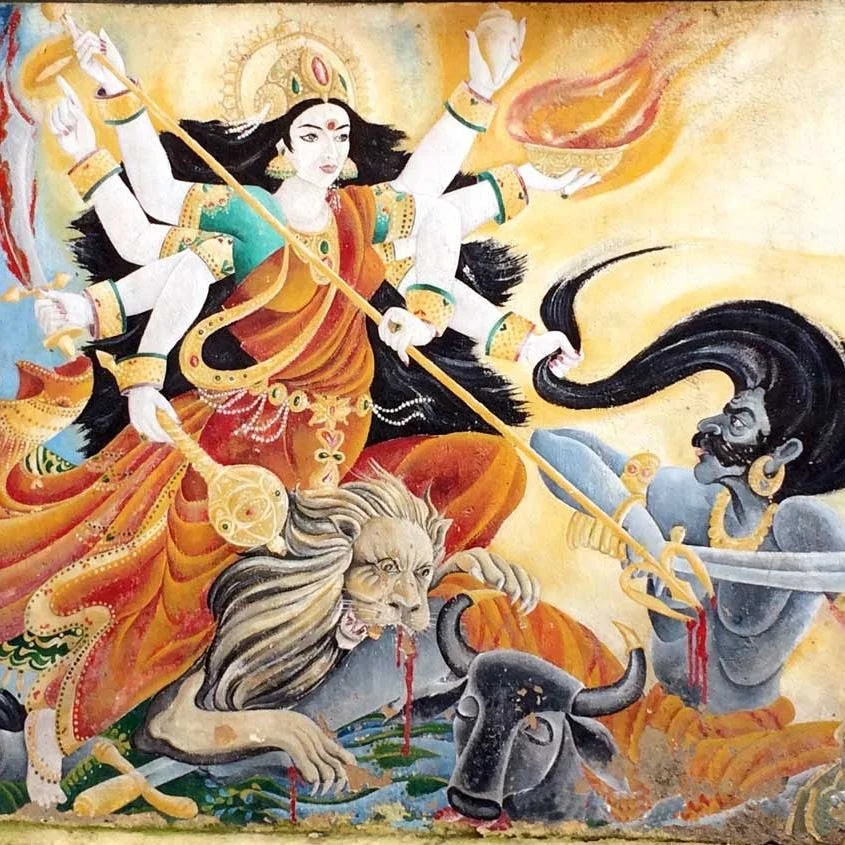
Ancient texts describe her radiant face as arising from Shiva, her luxuriant hair from Yama, her many powerful arms from Vishnu, and her steadfast feet from Brahma. Yet she was far more than the sum of their contributions. She was a wholly new manifestation of Divine Power itself.
The Gods did not merely create her - they armed her. Shiva placed his trident in her hands. Vishnu offered his spinning chakra. Vayu gave her bow and arrows. Other deities bestowed swords, spears, maces, and celestial weapons of every kind. From the fire emerged her great mount, sometimes depicted as a tiger and sometimes as a lion, symbolizing courage, sovereignty, and untamed power.
As the final prayers faded, the Gods gazed upon the Goddess they had brought forth.
Indra stepped forward and addressed her with reverence.
“Make us victorious, O Devi, Source of All Power. O Durga, who is difficult to comprehend and impossible to overcome, aid us in this hour of need.”
Durga's beauty was breathtaking, but within her eyes burned the fierce spark of battle. She regarded the assembled Gods and replied:
“Though I have arisen through your combined energies, know that I belong to no one. I am the spouse of none. I am beholden to none. To believe that I exist merely as an instrument of your will would be your greatest error.”
The Gods immediately understood. Before them stood not a servant, but a sovereign.
Humbled, Indra bowed and spoke again.
“O Durga, O Chamunda, Great Goddess, we honor your freedom and your power. You know the suffering that has befallen the worlds. We ask only for your mercy and your aid.”
Durga nodded.
Without another word, she mounted her tiger and ascended into the sky in search of Mahishasura.
The Gods remained behind, chanting hymns that would later become part of the sacred Devi Mahatmya. To this day, devotees recite these verses to invoke the protective and transformative power of the Divine Feminine.
When Durga arrived at the demon encampment, the armies laughed. They saw only a woman approaching them and assumed victory was certain.
Their arrogance proved fatal.
The battle that followed became legendary. Durga moved with terrible grace, wielding her many weapons with effortless mastery. The Devi Mahatmya delights in describing her ferocity as she shattered armies and defeated demons by the thousands. In some accounts she laughs amidst the carnage and drinks wine while waging war, embodying the ecstatic and untamed power of Shakti itself.
At last Mahishasura fell beneath her weapons, and cosmic balance was restored.
Returning to the Gods, Durga found them still gathered around the glowing embers of the fire from which she had emerged.
Pleased by their devotion and finding no deception within their hearts, she offered a promise:
“Whenever evil rises and overwhelms you, remember me. Chant my hymns, invoke my names, and I shall come.”
Then she departed.
Some traditions say she returned to the unmanifest state beyond form. Others place her among the Himalayan peaks or in the Vindhya Mountains. Still others envision her dwelling within forests and wilderness places, nurturing the natural world with her life-giving power.
Many ages later, when new demons arose to challenge the celestial order, the Gods again called upon Durga. They chanted her praises and sang her hymns, yet she did not immediately appear.
Searching for her, they ventured into a forest where they encountered Parvati beside a stream. When they explained their plight, Parvati smiled and from her own body Durga emerged once more, revealing the profound unity between the Goddess's many forms.
Durga agreed to aid them but lingered among the trees, communing with animals, spirits, and the living pulse of the forest.
Soon one of the demon brothers discovered her and became captivated by her beauty. Filled with arrogance, he demanded that she marry either him or his brother.
Durga smiled serenely.
“I shall marry the one who can defeat me in battle.”
The challenge led to another epic confrontation. Once again Durga laughed, flashed her weapons, drank her wine, and utterly destroyed the forces that opposed her.
Since that time, no demon has successfully threatened the celestial realms. Yet devotees continue to believe that whenever danger arises, whether external or within the human heart, Durga answers those who call upon her with sincere devotion.
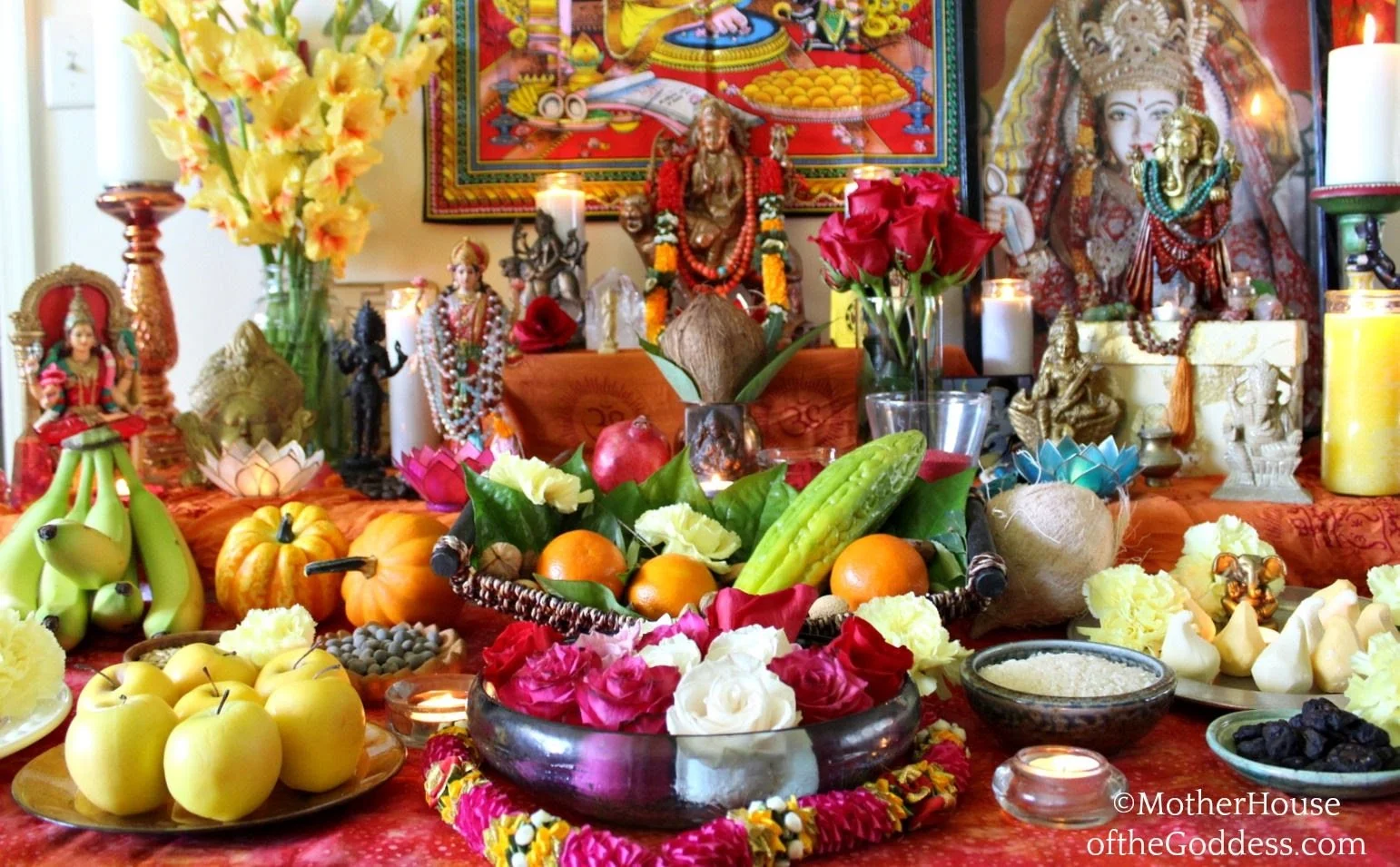
Today Durga remains one of the most beloved Goddesses of Hindu tradition. Her greatest festival is Navratri, the Nine Nights of the Goddess, celebrated annually according to the lunar calendar. During these sacred nights, devotees honor Durga along with Lakshmi and Saraswati as manifestations of the Great Goddess, Devi. Fasting, prayer, ritual worship, and recitations of the Devi Mahatmya commemorate the triumph of divine wisdom and courage over the forces of chaos.
Durga stands as the embodiment of sovereign feminine power. She is fierce yet compassionate, beautiful yet terrifying, nurturing yet utterly unstoppable. Unlike many goddesses whose identities are defined through marriage or motherhood, Durga remains radically independent. She refuses ownership, rejects limitation, and answers only to her own divine purpose.
Her mastery of maya, the sacred power of illusion, allows her to enchant and confound her enemies. Appearing vulnerable when she is strongest, she reminds us that appearances rarely reveal the whole truth. Though childless, she creates fierce female companions known as the Matrikas whenever battle requires allies, emphasizing her role as the source of feminine power rather than its subordinate expression.
Over time, Durga's role expanded beyond that of warrior. She became identified with the vitality of the natural world itself. The fertility of fields, the growth of forests, and the nourishment that sustains all beings are understood as manifestations of her life force. During Navratri she is honored not only as a destroyer of evil, but as the Life-Giver who feeds and sustains the world.
Some traditions link Durga to the ancient Goddess Vac, the personification of Sacred Speech and the creative power of divine utterance. Like the spoken word that brings reality into being, Durga is both creator and transformer.
Though she is often depicted wearing a red sari, I have always envisioned her clothed in shades of orange and gold, like living flame. Born from sacred fire, she carries within her the colors of embers, sunlight, and transformation itself.
Durga is the balance between the Terrifying Mother and the Mother of Boundless Love. She is the warrior who destroys obstacles, the protector who answers prayers, the power that nourishes the earth, and the fire that burns away illusion. For those who call upon her with sincerity, her promise remains unchanged across the ages:
Remember me, invoke me, and I will come.
RESOURCES FOR THE GODDESS DURGA
Awakening Shakti – the Transformative Power of the Goddesses of Yoga by Sally Kempton
Shakti Mantras – Tapping into the Great Goddess Energy Within by Thomas Ashley-Farrand
Tantric Yoga and the Wisdom Goddesses by Dr. David Frawley
Inner Tantric Yoga: Working with the Universal Shakti: Secrets of Mantras, Deities, and Meditation by Dr. David Frawley
Shakti – Realm of the Divine Mother by Vanamali
Encountering the Goddess: a Translation of the Devi-Mahatmya and a Study of Its Interpretation by Thomas B. Coburn
Hindu Goddesses: Visions of the Divine Feminine in the Hindu Religious Tradition by David R. Kinsley
Goddess Durga and Sacred Female Power by Laura Amazzone
RED PRIESTESS- Goddess Mists, Anointing Oils, and other magickal goodies by Priestess Brandi Auset